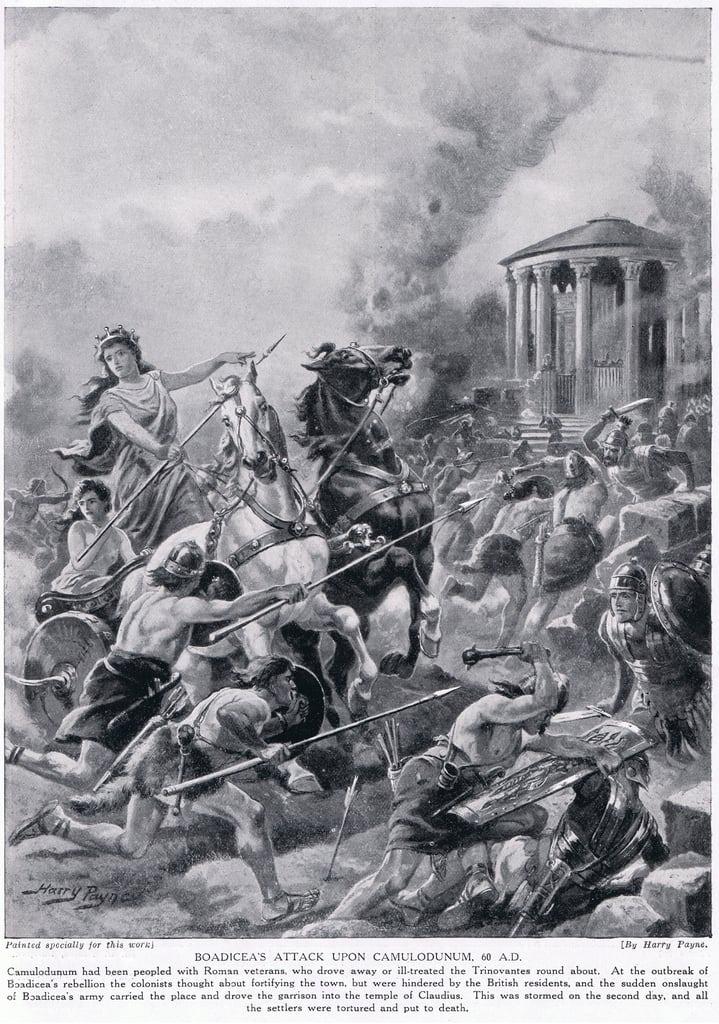
Boudica of Iceni (30 CE- c. 61 CE)
At the head of an army she built from the ashes of her kingdom, Boudica led one of the most devastating rebellions against Roman rule in Britain. While her rebellion was unsuccessful, she ultimately changed the way Romans treated the common people. Her legacy became a warning of what a united population could accomplish when pushed to rebellion.
The pragmatism of Boudica’s husband, Prasutagus, was intended to shield his family from harm in the event of his death by naming Emperor Nero of Rome as one of the heirs to his kingdom. Iceni was allowed to be an independent kingdom as long as Prasutagus remained loyal to the Roman government. Naming Emperor Nero as an heir was a political strategy, though one that would ultimately fail.
Following the death of her husband, Boudica was pushed aside when Rome chose not to honor the will Prasutagus left behind. They sent centurions to pillage the household, seizing land from the nobles and absorbing the kingdom completely under Roman rule. The household was treated like slaves. Boudica, stripped of her status, was publicly flogged while her daughters were violated at the hands of the Roman soldiers. Her kingdom was reduced to the status of a province, and with the help of surviving allies in her household and tribe, Boudica fled with her daughters to enlist the help of other clans in fighting the Roman occupation.
During her march across the country, Boudica and her army burned cities in their wake. Camulodunum, Londinium, and Verulamium were destroyed and between 70 and 80 thousand Romans, both soldiers and civilians, were killed during the uprising. Her army was defeated by Roman governor Suetonius Paulinus, leading to the end of Boudica’s rebellion. However, an unintended consequence arose. Roman leaders realized that her ability to unite multiple clans stemmed from the dissatisfaction among the people they governed. They came to the conclusion that in order to remove the possibility of another uprising and risking more Roman lives, they would have to adjust the way they treated the people they conquered. That adjustment became the lasting legacy of Boudica of Iceni.
Sources:
Tacitus, Annals (Book XIV)
BBC- Boudica
Encyclopedia Britannica- Boudica
Post a comment